

Exploring a New Frontier in Brain Health Through Reconstructive Microsurgery
The human brain has a remarkable natural system for clearing metabolic waste and maintaining a healthy environment for nerve cells. Increasing scientific evidence suggests that disruption of these clearance pathways may play a role in the development and progression of neurodegenerative diseases.
Neurolymphatic surgery is an emerging field that explores whether improving lymphatic drainage from the brain may positively influence neurological function and disease progression.
Dr Ben Moodie is involved in the clinical exploration of deep cervical lymphaticovenous anastomosis (LVA), a highly specialised supermicrosurgical procedure being investigated for its potential application in Alzheimer’s disease and other neurodegenerative conditions.
This approach represents an evolving intersection between neuroscience, lymphatic physiology and advanced reconstructive microsurgery.
Understanding the Brain’s Waste-Clearance System
The brain produces metabolic waste products during normal cellular activity. Efficient removal of these substances is essential for maintaining a healthy neurological environment.
Two interconnected systems have attracted considerable scientific interest:
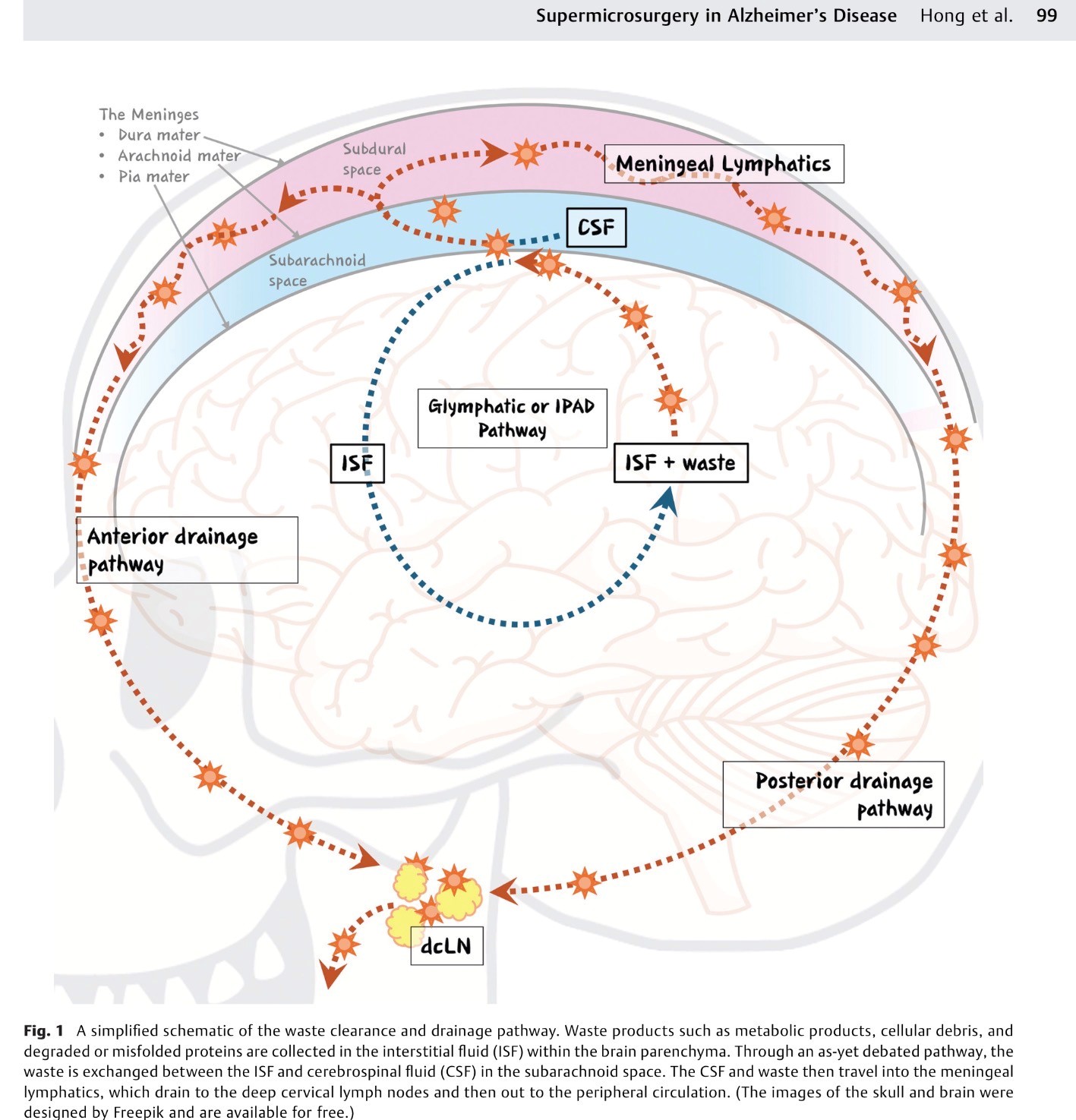
The glymphatic system facilitates the exchange of cerebrospinal and interstitial fluid within the brain, contributing to the movement and clearance of metabolic waste products.
The meningeal lymphatic system provides drainage pathways from the tissues surrounding the brain towards lymphatic structures in the neck, particularly the deep cervical lymph nodes.
Research suggests that these pathways may become less efficient with ageing and in certain neurological diseases.
In Alzheimer’s disease, for example, impaired clearance of proteins such as amyloid-beta and tau may contribute to their abnormal accumulation in brain tissue.
These discoveries have raised an important scientific question:
Could improving lymphatic drainage outside the brain help support the brain’s natural waste-clearance mechanisms?
This question forms the foundation of neurolymphatic surgical research.
What Is Deep Cervical Lymphaticovenous Anastomosis (LVA)?
Deep cervical LVA is an advanced microsurgical technique designed to create a direct connection between selected lymphatic vessels or lymph nodes in the neck and the venous circulation.
Using high-magnification surgical microscopy and specialised supermicrosurgical instruments, the surgeon identifies suitable lymphatic vessels and connects them to small adjacent veins.
The proposed objective is to provide an alternative route for lymphatic drainage, potentially reducing resistance within the cervical lymphatic outflow pathways.
Because the deep cervical lymphatic system receives drainage from structures associated with the brain and its surrounding tissues, researchers are investigating whether modifying these pathways could influence intracranial fluid clearance.
Importantly, the surgery is performed in the neck, not within the brain itself.
Although the microsurgical connections can be created, whether they meaningfully improve brain waste clearance or neurological outcomes remains under investigation.
Potential Applications in Neurodegenerative Disease
Neurolymphatic surgery is being explored primarily in the context of Alzheimer’s disease, where abnormalities in protein clearance and fluid dynamics are thought to contribute to disease progression.
Neurological conditions of scientific interest include:
- Alzheimer’s disease: Associated with amyloid-beta and tau accumulation, neuronal dysfunction and progressive cognitive decline.
- Parkinson’s disease: Characterised by dopaminergic neuronal degeneration and abnormal alpha-synuclein accumulation.
- Dementia with Lewy bodies: Associated with alpha-synuclein pathology and progressive cognitive, behavioural and movement-related symptoms.
- Progressive supranuclear palsy (PSP): A neurodegenerative condition involving abnormal tau accumulation.
- Frontotemporal dementia (FTD): A group of disorders associated with progressive degeneration of frontal and temporal brain regions.
- Huntington’s disease: An inherited neurodegenerative disorder characterised by abnormal Huntington protein and progressive neurological dysfunction.
Although these conditions differ considerably in their underlying pathology, growing research into brain-fluid dynamics and protein clearance has created interest in whether lymphatic pathways could represent a future therapeutic target.
Evidence for a clinical benefit from deep cervical LVA remains preliminary, particularly outside Alzheimer’s disease. The potential relevance of this approach to other neurodegenerative disorders is currently theoretical or exploratory.
What Does Current Research Show?
Early clinical publications have described the use of cervical lymphaticovenous procedures in patients with Alzheimer’s disease, with some reports suggesting improvements in selected cognitive, behavioural or functional measures following surgery.
Certain reports have also described changes in neurological imaging and biomarkers.
These findings are scientifically interesting, but important questions remain unanswered:
- Does the procedure reliably improve lymphatic drainage associated with the brain?
- Can improved drainage meaningfully influence abnormal protein accumulation?
- Are reported neurological improvements sustained over time?
- Which patients, if any, are most likely to benefit?
- What are the long-term safety considerations and clinical outcomes?
Small observational studies and individual case reports cannot establish treatment efficacy or distinguish a true surgical benefit from other influences.
Larger, well-designed controlled clinical trials will be essential before neurolymphatic surgery can be considered an established treatment for neurodegenerative disease.
Dr Ben Moodie’s Approach
Dr Moodie’s work in neurolymphatic surgery builds on his extensive experience in reconstructive microsurgery, free tissue transfer and delicate small-vessel anastomosis.
Deep cervical LVA requires precise identification and manipulation of exceptionally small lymphatic and venous structures, using techniques developed within the field of supermicrosurgery.
His interest in this emerging field centres on the possibility of applying established microsurgical principles to a new and challenging area of neurological research.
The objective is to explore this approach through careful patient selection, multidisciplinary collaboration, and ongoing evaluation of the available scientific evidence.
Is Neurolymphatic Surgery an Established Treatment?
No. Neurolymphatic surgery for Alzheimer’s disease and other neurodegenerative conditions remains experimental.
Although early findings have generated interest, there is currently insufficient high-quality clinical evidence to establish that deep cervical LVA reliably improves cognition, neurological function or long-term disease outcomes.
It should not be regarded as a cure, a proven method of slowing neurodegeneration, or a replacement for established medical and neurological treatment.
Patients considering this procedure require a thorough understanding of its potential risks, uncertain benefits and investigational status.
Enquiries and Patient Assessment
Patients and families wishing to learn more about neurolymphatic surgery may contact Dr Moodie’s practice for further information.
Any consideration of the procedure requires individual assessment, review of the neurological diagnosis, relevant investigations and multidisciplinary discussion where appropriate.
Medical aid coverage: As neurolymphatic surgery for neurodegenerative conditions remains an emerging and experimental treatment, it is not currently recognised as standard of care and is generally not covered by medical aid schemes or other healthcare funders. Consequently, the procedure requires private funding and may represent a significant financial commitment for patients and their families. It is important that these financial considerations are fully understood before proceeding with treatment.
Neurolymphatic surgery is an emerging investigational approach. Information on this page is provided for educational purposes and does not constitute evidence of an established or guaranteed treatment benefit.
DON'T ONLY PRACTISE YOUR ART BUT FORCE YOUR WAY INTO ITS SECRETS; ART DESERVES THAT.
Beethoven, 1812
DR MOODIE
Dr Moodie knew that he wanted to become a surgeon from the onset of his medical school training at the University of Pretoria, finding the opportunity to repair the human body extraordinary.
His logo, which you see on this website, was inspired by a sculpture by Reghardt van der Meulen “Fragmented“.